
The One Thing AI Cannot Create
Our Greatest Technological Achievement May Become Our Greatest Act of Self-Discovery

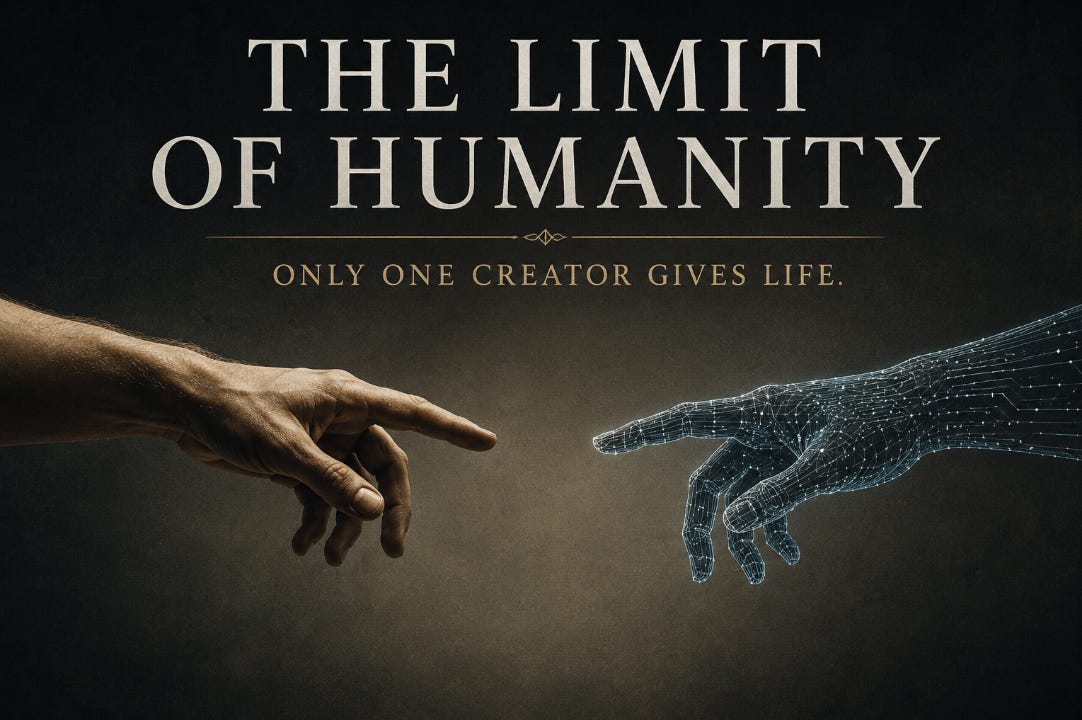
The apex of human intelligence brings us full circle back to its limits. Many will see an irony in this, but it is far better that we see divinity instead.
AI is the outer limit of human intelligence. What the computer did for our powers of intellect, AI is doing for computers. And more. We have created it, but what it will do with this power, we do not truly know.
Like a satellite, we are launching it on a voyage that will send it beyond the limits of what we know. AI is truly an awesome force; as such, it is an awesome testament to the power of human understanding that created it.
The span of Homo sapiens has been short. Science tells us just over 300,000 years. “Thinking man,” for that is what the Latin name means, has been and is a creature without equal. Our ability to reason and create has separated us from all other species. Sadly, it is also the most effective means of separating us from our creator.
The apple in Eden. The tower of Babel. Countless discoveries and inventions since. Each has closed the gap between our species’ comparatively humble physical attributes and those of the other species. Our created tools have allowed us to surpass other species, even in attributes—speed, flight, strength, sight—that they originally surpassed us in.
In many cases, they have allowed us to control the very forces of nature.
These have made us powerful. They have also made us prideful. What need we of God when we have made ourselves like gods? The result has been falling levels of belief and faith. And falling most where we are most well off; where the return of humanity’s intelligence has been most fruitful.
Now, we are poised to take the next intellectual leap. Likely a quantum one. Into the unknown.
We are already treating our AI creation like ourselves. People talk to AI as though to people. They imbue it with images that AI creates. AI has become for many more real than reality itself. Teens are said to reveal their true selves to it.
Yet in the end, and although we may choose to ignore it, we know AI is not “real.” Yes, it is real technology. Yes, it is really powerful. Yes, we can veil it with the trappings of reality—making it look, sound, and seemingly reason, like us. However, we “feel” in the end it is not “real.”
But if it is arrayed with our characteristics, how do we know it is not “real?” For many, it is. Increasing numbers of people cannot tell the difference between AI images and the real thing. An AI-generated fight scene between images of Tom Cruise and Brad Pitt sent Hollywood into paroxysms of angst over its level of quality. To many viewers, it’s already indistinguishable. And with AI still in its infancy, it will only get better at replicating human attributes of creation and presentation.
There are also consumers of AI who do not care that its creations are not human-made. Recently, The74 published an article with a headline that read “Survey: Young People Turn to AI to Be ‘Their Real, Unfiltered Selves.” The article quotes Alison Lee, one of the authors of a March 2026 study based on data from a nationwide survey of over 2,000 Americans aged 13 to 24. The survey found that roughly one in seven “young people are in relationships with ‘personified AI’ characters.” The survey also found “18% use AI for personal and relational support, such as venting about a tough day, seeking relationship advice and processing emotions.”
Of course, AI is likely to have greater penetration into the younger segments of society, who are the most technologically attuned. However, AI’s perceived ability to address the needs many of the young feel are hardly limited to that age group alone.
So, we come back to the question: What makes AI unreal?
For those with faith, the answer is simple: AI can produce seemingly unlimited intelligence but not the ineffable quality of a soul. For those without faith, the difference between humans and AI, between the real and the unreal, is far harder to answer. They must search for a quality in the rapidly decreasing number of things that separate humanity from AI. Eventually, they will be driven to find a name for that ineffable quality—between real and unreal—standing between it and us.
Throughout humanity’s existence, the greatest strength that God has given us—the gift that the Old Testament tells us Solomon requested (1 Kings 3:1-15) from God—wisdom has been a dual-edged sword for us. If properly used, it drives us to seek God and find him in the multitude of wonders and mysteries of his creation. As the Book of Proverbs (1:7) states in its opening: “The fear of the Lord is the beginning of knowledge.” Yet, it can also serve us so well that we take undue pride in it. And in ourselves. If misused, it can drive us from God: the beginning of knowledge becoming a cessation of a fear of the Lord.
It is no surprise that religion is least important among the most affluent societies. To their minds, they have provided for themselves; what need have they of outside intervention—an intervention, which if acknowledged, will only diminish their appraisal of their perceived accomplishments.
This brings us back to AI, the apex of our intelligence and a ramp that could take us beyond our own intelligence. Yet for all our value of intelligence and the wonders that humanity has wrought with it, there remains that ineffable thing that it cannot do. Neither it, nor we, can create a soul. And if AI, with its seemingly infinite ability, cannot, then neither can humanity. Only God can.
While we can create in our own image, only God can create us in his. As the Book of Wisdom (15:9-11) chides the maker of idols who “counts it his glory that he moulds counterfeit gods…because he failed to know the one who formed him and inspired him with an active soul and breathed into him a living spirit.”
There is more than irony that our greatest example (AI) of our greatest strength (our intellect) also reveals to us our ultimate limit: Divinity’s imprint, the pinnacle we cannot attain.
AI’s unexpected triumph will be if it brings us back from our own hubris in our wisdom and makes us search again for an answer to the question of what is greater than it. Greater still if it also reminds us that while our intellect is our greatest strength, it is not our greatest attribute. This greatest attribute remains our soul. For although other species reason, no other has a soul. This is something we alone have and something—perhaps soon to be the only thing—we cannot create.
J.T. Young is the author of the recent book Unprecedented Assault: How Big Government Unleashed America's Socialist Left, published by RealClear Publishing. Follow him on Substack.