

Recently, Jesus’ Parable of the Laborers (Matthew 20:1-16A) has been thrust before me. I read it; I heard it at Mass. A friend of mine told me he had been listening to Bishop Robert Barron (who another colleague of mine, Dr. Paul Kengor, calls “the most influential and well-known of all American churchmen today”) speak on YouTube about this parable. RealClear Religion included Bishop Barron’s talk (Love God—Not His Benefits) in a recent lineup. It was inescapable—as all Jesus’ parables were meant to be.
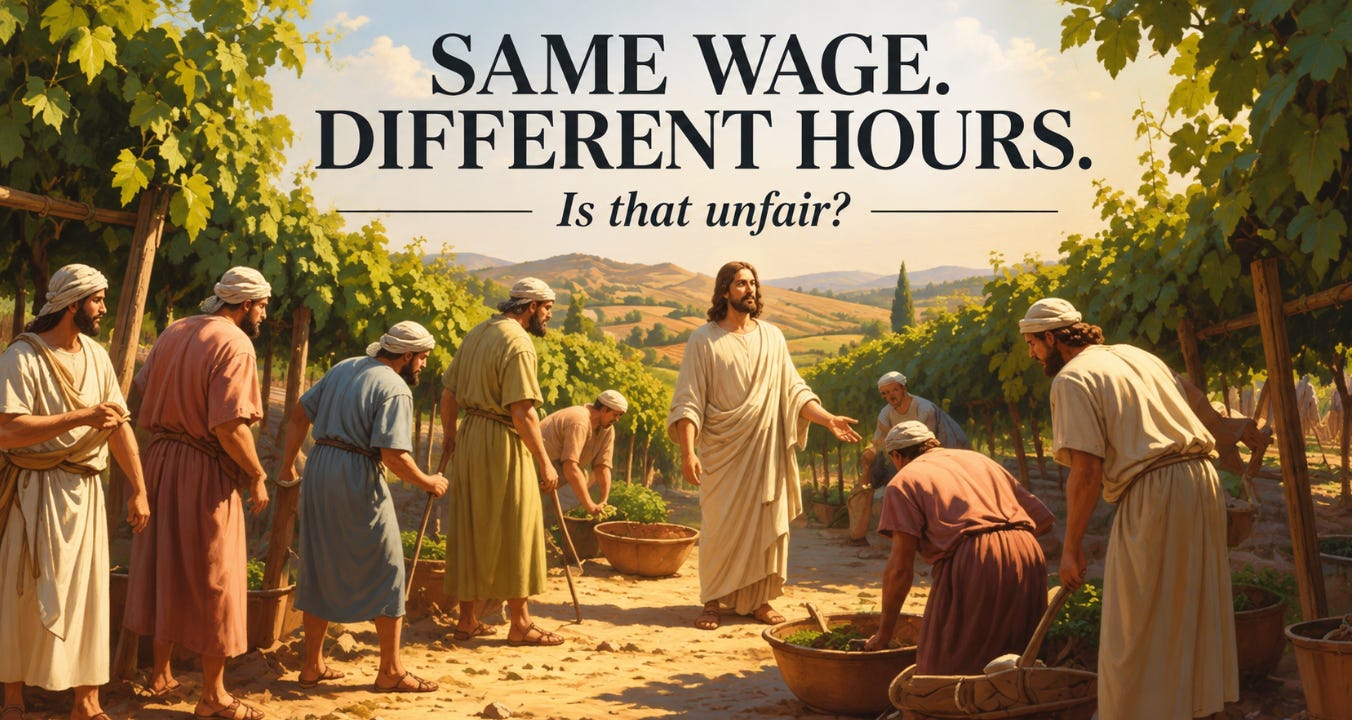
The parable is about a man who hires laborers throughout the day, from dawn to dusk, and sends them into his field to work. At day’s end, all are paid the same daily wage. The laborers who worked all day feel shortchanged when they see those who worked only an hour receive the same pay. Of course, the parable is a metaphor for our own lives: Those who work all day (their whole lives) receive the same blessing of heaven as those who labor but an hour (finding salvation only at the end of their lives).
Bishop Barron’s message on the parable is that we should not worship God because of His rewards to us but, instead, use His rewards as the means to finding the fuller route to Him: The means become the end.
My question on the parable is somewhat different: Is the “labor” really a labor at all?
Jesus’ parable of the laborers parallels another of His parables: The Prodigal Son (Luke 15:11-32). At the end, we see the prodigal son’s elder brother refusing to go into the house when the prodigal returns. Why? Because the elder son had done his father’s bidding all along and received nothing, while the prodigal son had scorned his father but now is welcomed back with open arms. The Parable of the Laborers also parallels the disciples who tell Jesus they have given up everything to follow Him (Matthew 19:27).
At the core of each of these three episodes is the sense of sacrifice that comes with following God. An implicit “deal,” in which we suffer now in this life to later reap the reward of eternal life.
The same sentiment is captured by Billy Joel in “Only the Good Die Young”:
“They say there’s a heaven for those who will wait
Some say it’s better but I say it ain’t
I’d rather laugh with the sinners than cry with the saints
Sinners are much more fun…”
My question is whether we are too hasty in equating earthly service to God as “labor,” as a sacrifice.
Billy Joel identifies saints with crying. Yes, there are moments of tears in every saint’s story; yet reading their whole stories, we find that saints are the most joyous and fulfilled of people. In many cases, they are willing to sacrifice all. Their tears are not for the sacrifice; these are for sins—those of others, as well as their own.
And yes, sinners laugh. But how long does the laughter last? And on what is it based? How many of the indulged sins are really that pleasurable? Look at what they have done to those who continue to indulge in them. Ask the members of rock and roll’s 27 Club. Sadly, any age could be taken, because so many were taken before their time.
Would you really want to go through life in the lyrics of Pink Floyd’s song, “comfortably numb?” To be drunk day after day? To cheat on your spouse? To have stolen whenever the opportunity presented itself? To have lied constantly?
Are these the missed “pleasures” that people really lament? If you partook of them as habitually as some claim to miss their ability to indulge, where would you be?
Would you really feel better? Be happier? More fulfilled in an earthly way—let alone an eternal one?
I offer that you would not. And not simply from the justifiable opprobrium that would come from these sins’ discovery. But from the behavior itself.
Therefore, I also offer the reverse: We are happier in following God’s way.
The laborers who were really short-changed are the laborers who were there only an hour. That the “labor” is indeed its reward as much as the payment is.
We do receive a very real and very substantial earthly reward in our spiritual pursuits. It is not a zero-sum game here, but a positive-sum one. The players are all better off.
The zero-sum game sin appears to be (realizing earthly pleasures here and repaying in the next life) is really a negative-sum game. It is so, certainly, overall (the loss of heaven being far greater than any earthly pleasures that could be obtained), but it is so even in this world. That sins diminish our lives here and now. That those who stay on sin’s course would be, not only the first examples of this, but that they would be the first to attest to this.
Go to an Alcoholics Anonymous (AA) meeting and see how many are still reveling in their former “good times.” The same applies to all other aspects of sin that we imagine can be escaped without consequence. And finally, that most people who follow their sins’ courses would readily accept the ability to get their joy in some other way.
The parable’s lesson is, of course, that we are all dependent on the generosity of the man (the Man) doing the hiring. That if we truly received our “just compensation” we would all suffer. That we are all being “paid” more than we are “owed.” Therefore, do not begrudge another; rather, be grateful in the Hirer’s generosity.
But we should also realize that the Hirer has truly been more generous to those who were in his fields the longest. St John Paul II wrote:
“Since the moral order reveals and sets forth the plan of God the Creator, for this very reason it cannot be something that harms man, something impersonal. On the contrary, by responding to the deepest demands of the human being created by God, it places itself at the service of the person’s full humanity…”
In the end, we not only find the way to eternal life with God; we find the best way through life with Him as well.
J.T. Young is the author of the recent book, Unprecedented Assault: How Big Government Unleashed America’s Socialist Left from RealClear Publishing. Follow him on Substack.